
EAT

Essay Assessment
Technology
Supporting meaningful learning through AI-powered feedback
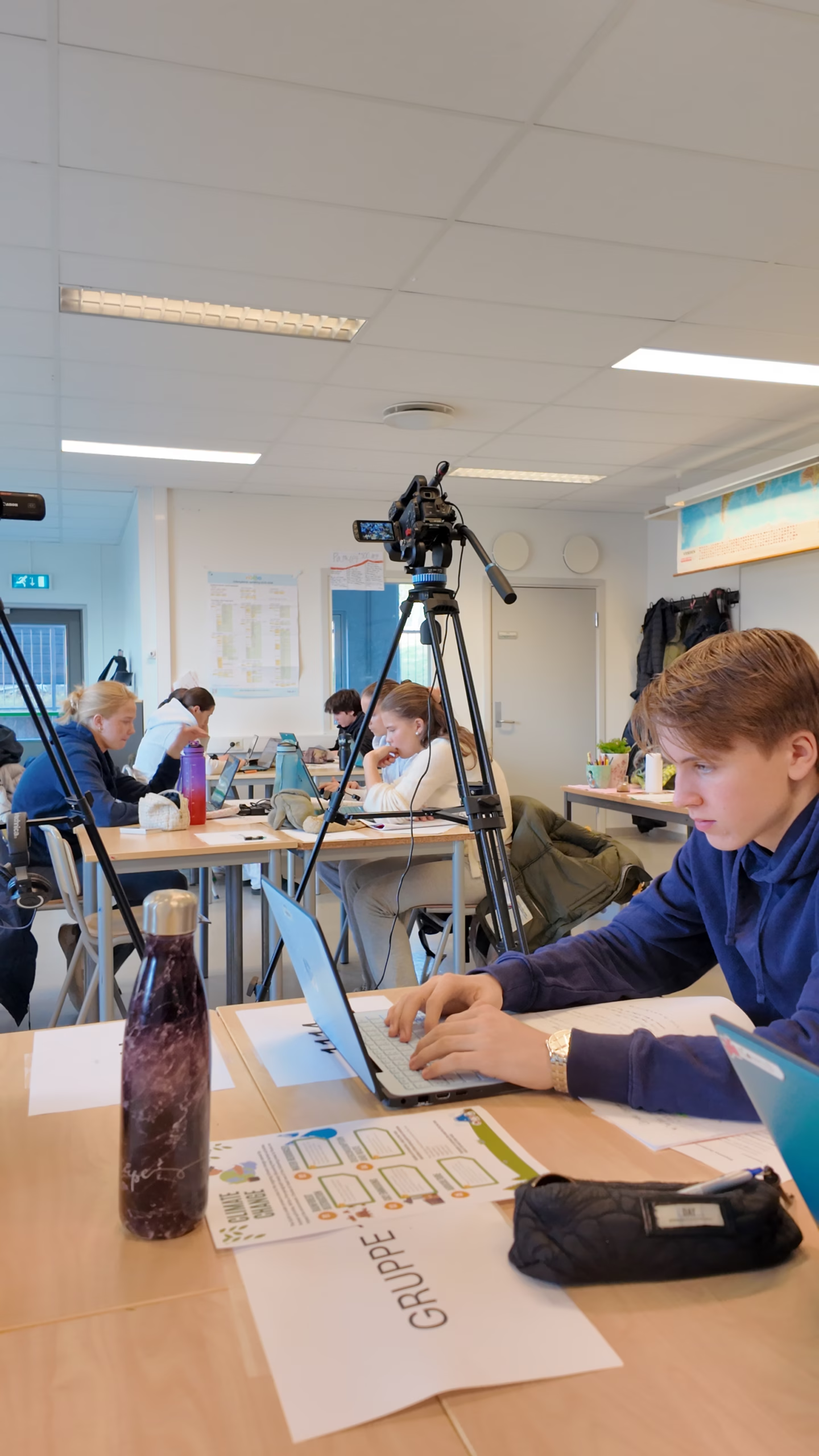

Students who used EAT showed measurable improvement in grammar, structure, and clarity.
Students began to internalize writing standards and feedback practices, supporting self-regulation and independent thinking.
Teachers reported that EAT helped operationalize formative assessment strategies that were previously hard to implement in large classrooms.
EAT analyzes students' texts and provides automatic feedback based on the grammar, content, structure, and organization of student texts. This provides students with concrete, subject-specific support to improve their texts through multiple drafts, and helps teachers strengthen assessment practices in the classroom.

Watch Essay Assessment Technology in action
The Need for EAT – The Pedagogical Context
Offering clear and constructive feedback on student writing is both time-consuming and demanding—especially in large classes and with complex assignments. As a result, many students receive limited guidance throughout the writing process, reducing their opportunities for conceptual understating and deep learning.
Essay Assessment Technology (EAT) helps to address this challenge by supporting both students and educators in the assessment process. With automated, content-specific feedback, students can improve their writing as they work, while teachers gain a tool that enhances assessment practices that reduces workload, enabling more time for more focused, pedagogical support.
EAT makes it possible to combine quality, adaptation and scaling in writing education – for the benefit of all students.

What is EAT?
EAT is a digital tool that uses AI to analyze student writing and offer feedback on:
Language
Grammar, spelling and punctuation
Content
Covered and suggested subthemes

Structure
Paragraphs, thesis and transitions
Organisation
Argument flow
EAT
Is developed by Østfold University College, Volda University College, and Hypatia Learning, through the AI4AfL project funded by the Norwegian Research Council.
Research Results from Using EAT

Improved Text Quality
Students who used EAT showed measurable improvement in grammar, structure, and clarity.
Deeper Understanding of Writing
Students began to internalize writing standards and feedback practices, supporting self-regulation and independent thinking.
Enhanced AfL Implementation
Teachers reported that EAT helped operationalize formative assessment strategies that were previously hard to implement in large classrooms.
How to Use EAT
A built-in checklist helps students stay aligned with assignment goals throughout.
1.
Write your first draft in the EAT interface.
2.
Receive AI-generated feedback.
3.
Discuss feedback with peers and/or teachers.
4.
Revise the draft based on insights.
5.
Submit final version for teacher evaluation.
Design Principles of EAT
Inspired by Galperin’s theory of mental development, EAT was built on seven design principles:
1.
Target Concept Alignment
Feedback aligns with learning goals and assessment criteria.
2.
Learner-Centred Framework
Students co-construct their learning pathways.
3.
Process Visibility
The entire writing process is transparent and trackable.
4.
Tangible Feedback Resources
Feedback is presented in visible, structured formats.
5.
Collaborative Spaces
Supports peer and teacher discussion around feedback.
6.
Reflective Dialogical Engagement
Promotes internal dialogue and deeper revision.
7.
Integrated Teacher Facilitation
Teachers can monitor and support progress in real-time.
What students say about EAT
“EAT provides more comprehensive feedback than a teacher can manage in a class of 30 students.”
“EAT offers really good feedback not only about what I’ve done wrong and can improve, but also about what I’ve done well and should keep doing.”
“I’m able to write much better texts with EAT than I could before.”
What teachers say about EAT
“Artificial intelligence helps to strengthen the teacher’s role – not replace it. We (teachers) use EAT as a tool to provide meaningful feedback so that students can write better texts and, most importantly, learn.”
“EAT clearly shows what students need to work on – what they can add, and how to improve the language, structure, and organization of their text.”
“EAT is an incredibly useful and supportive tool.”
For Educators
Why use EAT in your classroom?
- Scalable and formative feedback.
- Bridges AI with pedagogical intent.
- Promotes writing process awareness.
Training available for teacher integration and follow-up feedback practices.
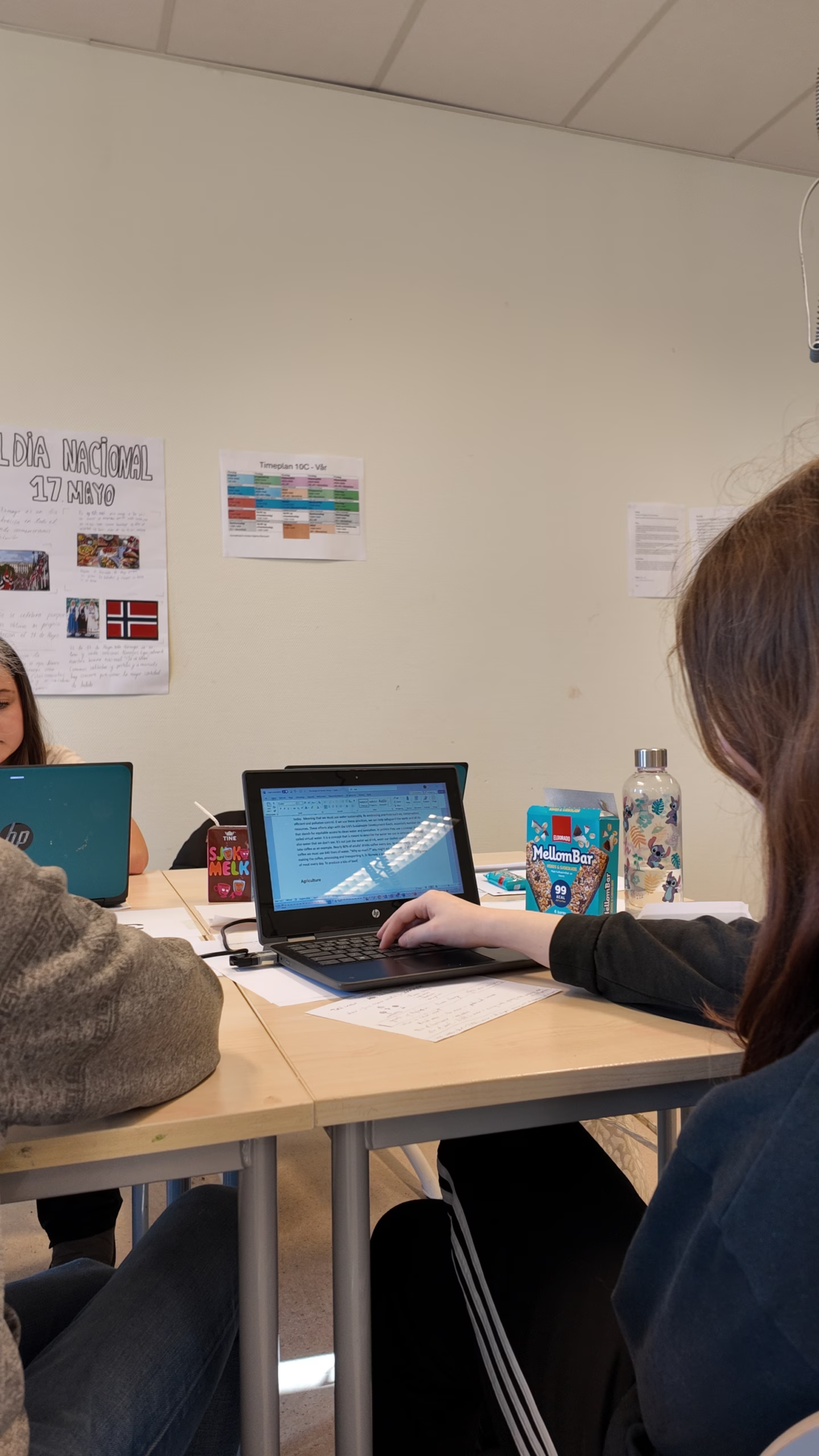
Essay Assessment Technology
PROCLUS Educational AI
Would you like to try EAT or start using it:
Research & Development
EAT was developed in the research project AI4AfL – Artificial Intelligence for Assessment for Learning, with support from the Research Council of Norway.
Learn more about the pedagogical and theoretical foundations in our peer-reviewed article:
“Exploring AI-Driven Feedback as a Cultural Tool” (Engeness & Gamlem, 2025).
Forskningsartikler
Engeness, I. Cultural-Historical Perspective to Design Pedagogical AI for Enhancing Student Writing. Tech Know Learn (2025). https://doi.org/10.1007/s10758-025-09876-0
Segaran, M., Engeness, I., & Gamlem, S. M. (2025). Lower secondary school teachers’ facilitation of students’ writing process: a study of automated feedback and peer feedback approaches. Computer Assisted Language Learning, 1–26. https://doi.org/10.1080/09588221.2025.2539154
Moltudal, S. H., Gamlem, S. M., Segaran, M., & Engeness, I. (2025, March). Same assignment—two different feedback contexts: lower secondary students’ experiences with feedback during a three draft writing process. In Frontiers in Education (Vol. 10, p. 1509904). Frontiers Media SA. https://doi.org/10.3389/feduc.2025.1509904
Segaran, M. K., & Moltudal, S. H. (2025). A Qualitative Descriptive Study of Teachers’ Beliefs and Their Design Thinking Practices in Integrating an AI-Based Automated Feedback Tool. Education Sciences, 15(7), 910. https://doi.org/10.3390/educsci15070910
Here you can give us feedback about EAT and Proclus.
We greatly appreciate your input – it helps us improve and further develop the tools.